
Table of Contents
You have built something real. Your clients get results. Your referrals are solid. People who work with you send others your way. And yet when a prospective client searches online for what you do, your website is nowhere near the top.
Someone with less experience, a shorter track record and a less impressive client list is sitting above you. You know their work is not stronger. Their online presence just is.
This happens to established professional services businesses more than almost any other category. Medical practices. Financial advisory firms. Legal practices. SaaS founders. Businesses that are genuinely excellent at what they do, with no dedicated marketing team and a website that stopped reflecting the calibre of their work somewhere around three years ago.
The gap between the quality of your actual work and your visibility online has a specific explanation. And that explanation is something you can do something about. It comes down to domain authority.
What Is Domain Authority?
Domain authority is a measure of how much trust your website has built with search engines over time.
A simple way to look at it: imagine word-of-mouth reputation in a professional community. A firm that has been operating for years, gets mentioned regularly by respected peers, and shows up consistently in the right conversations earns a level of trust without needing to prove itself from scratch each time. A newer firm with no track record has to work harder to earn that same confidence.
Domain authority works the same way, but the community is the internet and the trust signals are digital.
It is measured as a score between 0 and 100. The higher your score, the more credible and established your website appears to search engines like Google. That credibility influences whether your site surfaces when a prospective client searches for what you do.
The score is calculated from three main signals:
-
The quality and quantity of websites linking to yours
-
How much organic traffic your site earns from search
The score is tracked using third-party SEO tools. Moz created the original Domain Authority metric. Semrush calls their version Authority Score. The tool name differs; the underlying concept is the same. Both give you a useful benchmark for tracking progress and comparing your site against competitors in your niche.
A few things worth knowing before you spiral over your score:
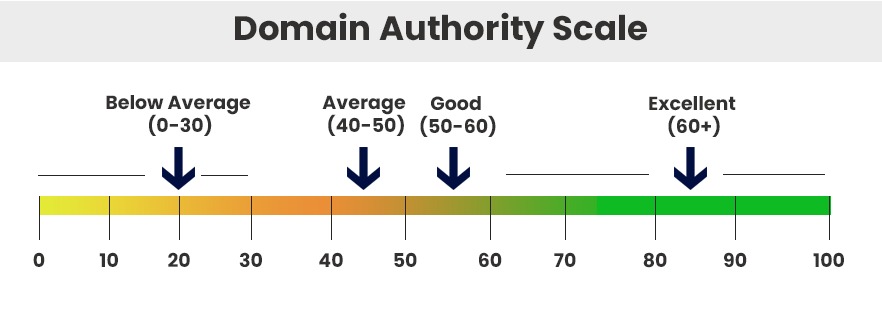
The score is relative, not absolute. Scores between 40 and 50 are considered solid for most small businesses. Scores between 50 and 60 represent strong authority. Anything above 60 puts a site among the elite in most industries. What matters is how your score compares to the businesses competing for your same clients, not against global media companies with teams of SEO specialists.
It is also a long game. Domain authority builds over months and years. Anyone promising dramatic score increases in 30 days is describing a tactic that typically creates short-term spikes and longer-term penalties.
What About AI Search? Does Domain Authority Still Matter?
Domain authority no longer only influences where you appear in Google. AI search tools including ChatGPT, Gemini and Perplexity now draw on the same underlying trust signals when deciding whose content to surface in response to a query.
When a potential client asks an AI tool a question that your business should be answering, whether your website gets cited or ignored depends significantly on the trust and authority signals you have built. For SaaS founders and tech businesses in particular, this is happening right now. Getting ahead of it is a strategic advantage worth taking seriously.
If you want to understand how to find the words your prospective clients are actually typing into Google, start with this keyword research guide for small business owners — it pairs directly with what we cover here.
Why Established Professional Services Businesses Are Particularly Exposed
Google applies its highest trust scrutiny to websites in industries where inaccurate or unhelpful content could cause real harm. Medical practices, financial advisory firms and legal practices all sit in this category. Google calls it YMYL, which stands for Your Money or Your Life.
Research analysing 10 million search results found that trust-related signals influence approximately 8% of ranking weight across all queries. For YMYL industries, that figure triples to around 24%.
Read that again. If your business is in medicine, finance or law, Google is applying three times more scrutiny to your website’s credibility signals than it applies to most other industries.
Here is what that means practically. A fertility clinic with 15 years of excellent patient outcomes and a website that has not been updated in three years is being evaluated against a newer clinic that publishes consistent, credible, well-structured content. Google does not have access to your patient outcomes. It has access to your website. And if your website is not signalling trust, expertise and consistent presence, you are losing ground to someone who is, regardless of who does better clinical work.
This is not specific to medicine. A financial adviser whose website looks like it did in 2021, a law firm with no substantive content, a SaaS business with a thin blog and no third-party mentions, all of them are facing the same structural disadvantage.
The framework Google uses to evaluate this is called E-E-A-T: Experience, Expertise, Authoritativeness and Trustworthiness. Google’s documentation on creating helpful, people-first content outlines exactly how these signals are evaluated. The full Search Quality Rater Guidelines is publicly available and worth scanning if you want to understand precisely what Google is looking for from your industry.
“Prospective clients are deciding before they reach you, based on what they find online. Your brand has to win those moments.”
The businesses that lose those moments are losing to better-branded ones. If this resonates with where your business is right now, this is exactly the work I do with established businesses, helping you close that gap strategically, without the overwhelm.
The 4 Levers That Build Domain Authority for an Established Business
Lever 1: Strategic, Consistent Content in Your Area of Genuine Expertise
Most established business owners I speak with have been creating content for a while. A blog post here, a few social captions there, maybe an email or two. They are not starting from zero. But the content has been spread across too many topics, published too inconsistently, and built without a clear strategic thread connecting it.
The result is a website that Google cannot confidently categorise. And a site Google cannot categorise is a site Google will not rank.
Here is how this works. Search engines are not just looking for pages that contain the right keywords. They are looking for websites that demonstrate genuine, sustained expertise in a specific subject area. When your content covers three different topics one month and two completely different ones the next, Google sees a generalist site with no clear authority in anything. When your content consistently goes deep on two or three topics your prospective clients are actively searching for, Google begins to recognise your site as a credible, specialist source on those subjects. That recognition is called topical authority, and topical authority is the content-side foundation of domain authority.
Google’s December 2025 algorithm update made this explicit. Sites with deep, focused expertise in a specific niche gained significant visibility. Sites covering broad topics without real depth lost ground to more specialised competitors. FreshBooks and Xero gained rankings for accounting software queries that broader platforms like Zapier and Adobe had previously held. Specialisation is now directly rewarded.
Research published by Graphite adds a finding worth noting here. When a piece of content builds topical authority and gains a significant traffic boost, the related articles on the same domain — the ones covering adjacent aspects of the same subject — grow alongside it. The authority compounds across the cluster, not just on the individual page. That compounding effect is exactly what makes this lever so powerful for an established business with genuine expertise to draw from.
Here is what this looks like in practice at scale. HubSpot’s blog attracts over 4.5 million monthly visitors. It is built entirely on the pillar and cluster model — comprehensive guides on core topics, supported by dozens of in-depth articles covering specific aspects of each subject, all connected through deliberate internal linking. The result is a site that Google recognises as the most authoritative source on marketing and sales topics across almost every relevant search query. HubSpot is not a small business. But the principle it demonstrates is available to any business willing to go deep on the topics it genuinely owns.
A framework worth using here is the pillar and cluster model:
A pillar piece covers a core topic thoroughly, serving as the main reference point for that subject on your site
Cluster pieces go deeper into specific aspects of that topic, each answering a more specific question
Each cluster piece links back to the pillar, and the pillar links out to relevant cluster pieces
Together they signal to search engines that your site has genuine depth in this space
The goal is not to produce more content. It is to produce the right content, consistently, in a way that builds a recognisable area of expertise over time. For a fertility clinic, that might mean a pillar piece on IVF success rates supported by clusters on preparation, timelines, costs and what to expect at each stage. For a financial advisory firm, a pillar on retirement planning supported by clusters on superannuation strategies, tax implications and investment risk by life stage. For a SaaS business, a pillar on the core problem their product solves, supported by clusters on every variation of that problem their clients search for.
If you want to understand how to build consistent visibility around your content without a large budget, this piece on community-led marketing for small businesses covers the thinking behind sustainable content presence.
Lever 2: Earning Quality Backlinks from Credible Sources
A backlink is a link from another website to yours
Search engines treat these as endorsements. When a respected industry publication, a professional association, a podcast or a trusted directory links to your content, it signals that your site is worth pointing people toward.
Quality matters far more than quantity here. Ahrefs’ research on backlinks and rankings consistently shows that one link from a relevant, trusted source carries more ranking weight than dozens of links from low-quality or unrelated sites.
For established professional services businesses, the most natural path to quality backlinks runs through existing credibility:
Being quoted or interviewed in industry media and publications
Contributing thought leadership pieces to professional associations
Speaking at conferences or events that publish resources and speaker bios online
Being listed in relevant professional directories and comparison sites specific to your sector
Collaborating on content with complementary businesses whose clients overlap with yours
What I see working really well here is leading with genuine expertise rather than pursuing a link. When a financial adviser writes a considered piece for an accountancy publication, the link back to their website is a by-product of the value they contributed. That is the most sustainable and credible path. It also compounds well with the personal reputation building that established professionals are already doing through other channels.
What to steer away from:
Paid link schemes
Link farms or mass directory submissions
Any tactic that manufactures links rather than earns them
These approaches create short-term score movements and long-term penalties. They also sit completely at odds with the credible, premium positioning that an established professional services business is working to build. Google’s spam policies for link schemes are explicit on this, and the penalties for crossing that line are not worth the short-term gain.
Lever 3: Brand Consistency Across Every Online Touchpoint
This is the lever that gets underestimated most consistently, particularly by businesses that have been operating for several years and have accumulated an online presence without really managing it.
Search engines build a picture of your business from every place your name, website URL and description appears online. Every mention contributes to what is called your entity footprint, which is the picture a search engine builds of who you are, what you do, and whether the information about you is coherent and trustworthy.
The touchpoints that contribute to this picture include:
Your Google Business Profile
Your LinkedIn company page and personal profile
Your team members’ LinkedIn profiles
Professional association directories and membership listings
Mentions in articles, podcast show notes and event pages
Any directory or review platform relevant to your sector
When that information is inconsistent — your business name appears in three slightly different formats, your website URL is missing from some profiles, your description says something different on LinkedIn than it does on your Google profile — search engines become less confident about your identity. That uncertainty quietly depresses your authority signals.
Run this audit this week. Search your business name. Go through the first two pages of results. Check every listing that appears. Is your name consistent? Is your website URL correct and present everywhere it should be? Is your description accurate and current? For businesses that have been operating for several years, this audit regularly surfaces inconsistencies that can be fixed quickly and at no cost.
For the medical and legal professionals I work with, this step matters beyond SEO. Outdated or inconsistent information in professional directories is a trust issue with prospective clients doing their due diligence before making contact. Getting it right serves the brand at multiple levels simultaneously.
Lever 4: A Website That Search Engines Can Actually Read
This is where the genuinely technical side of SEO lives. The good news is that most established businesses only need to address a small set of fundamentals to make a meaningful difference.
Page speed
Google measures how quickly your pages load as a direct ranking signal. A slow site loses visitors before they read a single word, and Google notices the pattern. Run your site through Google PageSpeed Insights, it is free, requires no account, and gives you a clear prioritised list of what to fix. Pass the results to your web developer with a brief tied to specific commercial outcomes.
Mobile experience
Most web traffic now comes from mobile devices. If your site is slow, hard to navigate or visually broken on a phone, that affects both your rankings and the first impression you make on prospective clients who are evaluating you before getting in touch.
Internal linking
Every time you publish a new piece of content, link it to related existing content on your site. Authority earned by your most linked-to pages can flow through to other pages when they are connected. Your strongest pages lift your less visible ones. A site where pages exist in isolation, with no internal links connecting related content, loses that compounding effect entirely.
No broken links
Links that lead nowhere signal poor maintenance to both visitors and search engines. Broken Link Checker is a free tool that scans your entire site and flags every broken link clearly, with no sign-up required.
Content structure for AI retrieval
AI search tools pull answers from content structured in clear, self-contained sections. Starting each section with a direct answer to the heading’s question, using question-based headings, and keeping paragraphs focused on one point each makes your content easier for both readers and AI systems to extract and cite. For a deeper look at how AI is changing how small businesses show up in search, this guide on using AI in your small business marketing is worth reading alongside this one.
For anything beyond these fundamentals, including technical audits, site architecture reviews or structured data implementation, the right move is to work with a trusted specialist. This is the one area where the investment in expert support pays off clearly, provided you go in with a clear brief tied to commercial outcomes.
What Steady Domain Authority Growth Actually Looks Like Here
Domain authority does not move in a week. What it does is compound.
Every quality piece of content published, every backlink earned, every inconsistency cleaned up in your online presence, every site improvement made adds to a growing foundation of trust. Over 12 to 18 months of steady, strategic effort, that foundation shifts where you appear when someone searches for what you do.
The businesses that build real, durable search visibility are not the ones producing the most content. They are the ones with a clear strategy, working within it consistently, building depth rather than chasing volume. A rhythm that fits how the business actually operates, rather than a content treadmill that burns out whoever is responsible for keeping it running.
If you feel behind on this, you are in good company. Many of the established businesses I work with start right here, with a strong professional reputation and a digital presence that has not yet caught up with the calibre of their actual work. The gap is closeable. The path to closing it is strategic, not frantic.
Where to Start This Week
Pick one lever and move on it before the week is out.
1. Your online presence is scattered Run the brand consistency audit. Search your business name and work through the first two pages of results. Write down every listing that surfaces, check it for accuracy and fix what is wrong. This costs nothing and typically takes less than an hour.
2. Your content has been ad hoc Identify the two topics you most want your business to be found for. Look at what you have already published and find your strongest piece. Make sure it is thorough, current and linking to related content on your site. Not sure which topics to prioritise? Find the words your prospective clients are already searching with this step-by-step keyword research guide.
3. Your site has not been reviewed recently Run it through Google PageSpeed Insights and pass the results to your web developer with a clear, outcome-focused brief. Ask specifically which fixes will have the biggest impact on load speed and mobile experience.
4. You have never thought about backlinks deliberately Write down three publications, professional associations or complementary businesses whose audiences overlap with yours. For each one, identify a genuine insight or piece of expertise you could contribute to their audience. Start with one outreach this week.
None of these actions will transform your domain authority this week. Over 12 months of doing them with a clear strategy underneath, they build something that matters commercially — a website that earns trust before a prospective client ever speaks to you.
Domain authority is a score between 0 and 100 that measures how much trust and credibility your website has built with search engines over time. The higher your score, the more likely Google is to surface your site when prospective clients search for what you do. For professional services businesses in medicine, finance and law, it matters more than most industries because Google applies its highest scrutiny to these sectors, meaning the bar for appearing in search results is already higher than average.
A good domain authority score for an Australian small business depends on your niche and competitors, not a universal number. Scores between 40 and 50 are considered solid for most small businesses, and most Australian professional services businesses sit between 20 and 45 — which is competitive within local and specialist niche search. What matters most is how your score compares to the businesses competing for your same clients, not against large national publications or global platforms.
Domain authority is not a Google ranking factor. Google does not use Moz’s Domain Authority score, or any equivalent third-party metric, in its ranking algorithm. It is a tool created by SEO platforms to predict ranking potential. What Google does use are the underlying signals those tools attempt to measure — quality backlinks, technical site performance, brand consistency and content depth — which is why improving your domain authority score through legitimate means tends to improve your search visibility over time.
Most businesses begin seeing early movement between three and six months when a clear content and backlink strategy is being executed consistently. Meaningful, sustained improvement typically takes twelve to eighteen months. The score operates on a logarithmic scale, so early gains come faster and progress slows as the score climbs. Anyone promising dramatic score increases in 30 days is describing a tactic that typically creates short-term spikes and long-term penalties.
Table of Contents
Share This