
What Google Uses to Build Your Entity Record
Source: Google Search Central
Search a business you admire and something interesting happens before you click a single result. A panel appears on the right side of the page — their logo, a confident description, their website link, maybe their founding year and services. It looks as though Google has personally vetted them.
Search your own business name. Depending on what you find, that comparison might be uncomfortable.
What separates those two experiences is not ad spend or follower count. It is whether your business has a well-established record in Google’s Knowledge Graph, and that is becoming more consequential every year as AI reshapes how people find answers online.
The Database Behind the Panel
Google’s Knowledge Graph is not a feature you apply for. It is an information database that Google has been building since 2012, and it contains data about entities, businesses, people, places, products, concepts, and the relationships between them.
When someone searches for your business name, Google checks this database. If it finds a confident, well-sourced record for your entity, it can display that information directly in the results. That is the knowledge panel. If it does not find a clear record, or if the information it has found is inconsistent across sources, it defaults to showing a list of links and leaving the reader to piece together who you are.
Here is a simple way to look at how the database works.
Google organises the Knowledge Graph using three components:
Nodes are the individual entities. Your business is a node. Your founder is a node. Your service category is a node. Each has a unique identifier so Google can distinguish between, say, a legal firm and a financial advisory practice that share a similar name.
Edges are the connections between nodes. The relationship between your founder node and your business node. The relationship between your business node and your industry category. These connections are how Google understands context.
Attributes are the specific details. Your business name, address, website URL, description, founding year. The more complete and consistent these details are across credible sources, the more confidently Google represents your entity.
The businesses with knowledge panels are the ones whose nodes, edges and attributes are clearly established and consistently verified across multiple sources Google trusts.
Why 2026 Changes the Stakes on This
Source: BrightEdge
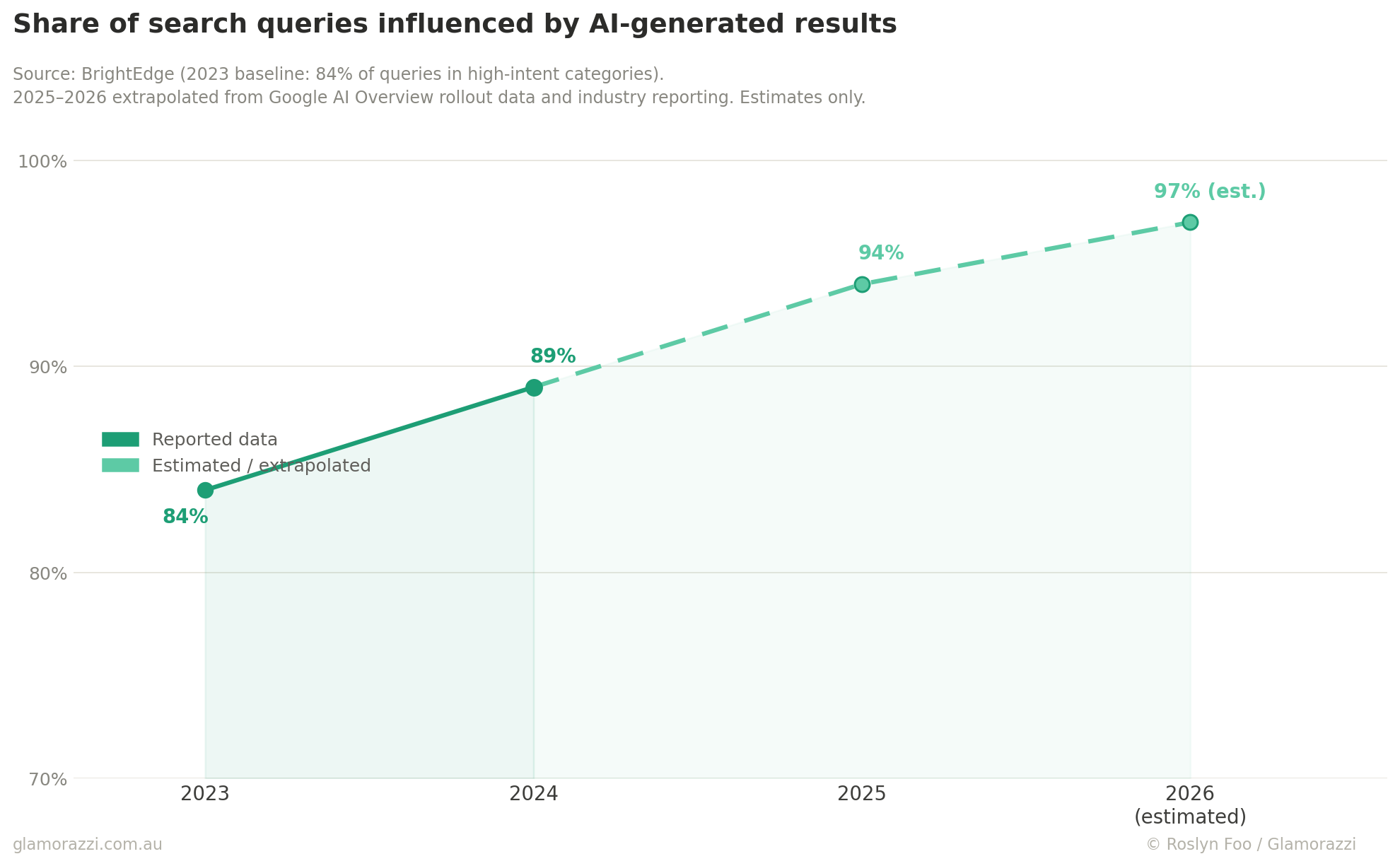
The Knowledge Graph has existed for over a decade. Most small business owners have been able to ignore it without significant consequences. That is changing, and the reason is AI search.
Google’s Gemini AI model is trained on the Knowledge Graph. This means how your business is represented in Google’s database directly influences whether and how you appear in AI Overviews, AI Mode responses, and Gemini-powered answers. When someone asks Google a question that your business should be answering, the Knowledge Graph is part of what determines whether your name surfaces in the response.
The reach goes further than Google. Tools like ChatGPT and Claude draw on many of the same underlying sources that populate the Knowledge Graph, including Wikipedia and authoritative directories. A business with a strong, coherent entity footprint in these sources tends to appear in AI-generated answers across multiple platforms. A business with a weak or absent footprint tends not to.
For professional services businesses this matters in a very practical way. Prospective clients are increasingly asking AI tools questions before they search at all. “Who are the most reputable IVF clinics in Melbourne?” “What should I look for in a financial adviser in Sydney?” If your entity is not clearly and confidently represented in the systems those tools draw from, you are absent from answers you should be part of.
“Google is not just matching keywords anymore. It is deciding which entities are credible enough to recommend. The Knowledge Graph is how it makes that decision.”
What Google Uses to Build Your Entity Record
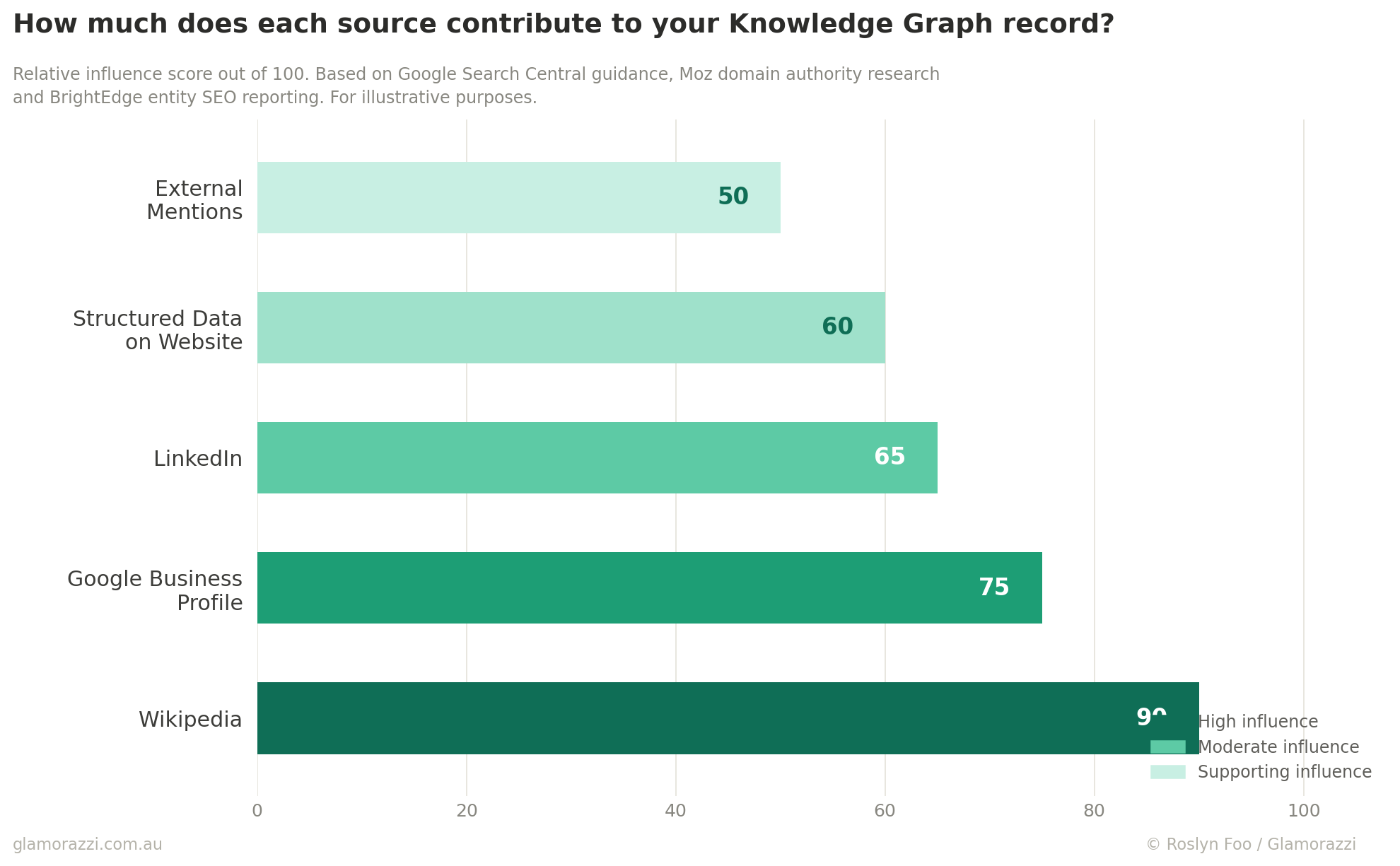
Google pulls information from a specific set of sources to construct and verify entity records. Knowing which sources matter most is what makes this actionable.
- Wikipedia carries the most weight of any single source. A Wikipedia page for your business, or for your key principals, signals notability at a level very few other sources can match. Wikipedia has strict criteria for what it considers notable, so this is not available to every business. For an established specialist practice with a genuine track record and meaningful external coverage, it is worth assessing seriously whether your business meets the threshold.
- LinkedIn is one of the most heavily indexed professional sources Google draws from. A complete, current LinkedIn company page with a consistent business name, accurate description, correct website URL and active content contributes directly to how Google understands your entity. Individual profiles for your key team members, connected properly to the company page, reinforce the network of relationships that the Knowledge Graph maps between people and the organisations they belong to.
- Google Business Profile gives Google structured, directly submitted information about your entity. For any business with a physical location or a defined service area, a complete and current Google Business Profile is one of the most direct contributions you can make to your Knowledge Graph representation. Categories, description, contact details, hours and genuine client reviews all feed into the picture Google builds of who you are and what you do.
- Structured data on your website allows you to tag specific pieces of information in a standardised format called schema markup that Google can read and verify with high confidence. Your business name, logo, address, contact details and services can all be marked up clearly using Organisation schema, which is the most relevant type for most professional services businesses. This is a developer implementation and straightforward to add. It gives Google a machine-readable source of entity information directly from the most authoritative source possible, which is your own website.
- High-authority external mentions from trade publications, professional association directories and credible industry media function as third-party verification of your entity. When a respected publication references your clinic, quotes your adviser or features your firm, Google treats that as corroborating evidence that your entity is real, established and credible in its field. These mentions do not need to be frequent to be effective. A small number of genuinely authoritative references carries far more weight than a large volume of low-quality directory listings.
Table of Contents
The Consistency Problem Most Established Businesses Have
Here is what I see regularly with businesses that have been operating for five or more years. They have accumulated an online presence organically, without really managing it. Their business name appears in slightly different formats across different directories. Their old website URL is still cached in half a dozen listings. Their LinkedIn description says something different from their Google Business Profile. Their founder’s name is connected to the business in some places and not in others.
Each of those inconsistencies sends a signal to Google that it cannot be fully confident about this entity’s information. And Google, when uncertain, either represents you less prominently or declines to represent you at all.
A one-off audit fixes most of this. The process is straightforward. Search your business name in Google and go through the first two pages of results. Every listing that surfaces, every directory, every association page, every mention, check it for accuracy. Is your business name consistent? Is your current website URL present? Is your description correct? Is your category accurate?
For the medical and legal practices I work with, this audit regularly surfaces listings from five or six years ago that have outdated contact information, old addresses, or superseded service descriptions. A prospective client doing due diligence before their first consultation is seeing that information. That is a trust problem that has nothing to do with the quality of the clinical or legal work. It is a purely administrative gap with real commercial consequences.
Claiming Your Knowledge Panel If You Already Have One
Some established businesses already have a knowledge panel without realising it. If one exists for your business, you can claim it, which allows you to suggest edits and maintain more direct influence over how your entity is represented.
To check, search your business name in Google. If a panel appears, click the three dots in the top right corner of the panel and select “Claim this knowledge panel.” Google will prompt you through a verification process. Once verified, you can flag any inaccurate information by clicking the corresponding flag icon within the panel and submitting a correction with supporting detail.
If a panel does not yet exist for your business, the path to earning one is building the entity footprint described above, consistently, across multiple authoritative sources, over time.
How This Connects to the Broader Authority Picture
The Knowledge Graph does not exist in isolation. It is one piece of a connected system that determines how credible and visible your business appears online.
Your domain authority, meaning the trust your website has built with search engines through content and backlinks, feeds into your entity’s overall credibility. Your brand consistency across directories, which directly supports your Knowledge Graph record, also contributes to your domain authority signals. Your structured data, your Google Business Profile and your LinkedIn presence each serve multiple functions simultaneously.
If you have not yet read how domain authority and website trust work for professional services businesses, that is the right companion piece to this one. And if you want to understand how AI is reshaping search visibility for small businesses more broadly, this guide on using AI in your small business marketing covers the strategic context.
The practical starting point, before anything else, is understanding what Google currently knows about your business. Search your name. Look at what surfaces. That is your entity as Google sees it right now. The gap between that picture and how you want to be seen is the work.
It is Google’s internal database of entities — businesses, people, places and concepts — and the relationships between them. Google uses it to display accurate information directly in search results, including the business panels you see on the right side of the page when you search a company name. If your business is in it, Google can represent you confidently. If you are not, Google has very little to work with.
There is no application process. Google builds and updates the Knowledge Graph by drawing from authoritative sources including Wikipedia, LinkedIn, Google Business Profile, structured data on your website and credible external mentions. The way to get into it is to make sure your business information is complete, accurate and consistent across all of those sources.
The Knowledge Graph is the database. The knowledge panel is what the searcher sees — the information box that appears in search results showing your logo, description, website and other details. The panel is powered by the Knowledge Graph. You cannot have a panel without a record in the database.
Most commonly it comes down to entity footprint. Your competitor likely has a more complete and consistent presence across the sources Google draws from — a well-maintained Google Business Profile, a complete LinkedIn page, consistent directory listings, possibly structured data on their website. The gap is closeable. It is administrative and strategic, not a reflection of who does better work.
Share This